
Much like the M1's that arrived a few decades before, the C3 coaches were to be built with no door traps and steps for low-level platform boarding. The C3's would be able to platform at high-level platforms only. As a result, the railroad had to go around and convert all of the remaining low-level platforms to high-level platforms.
Before this time, all of the stations on the Port Jefferson Branch had already be converted to high-level platforms and the C1 test cars were running on that branch during this time, but large portions of the Mainline east of Ronkonkoma and the Montauk Branch east of Babylon still had low-level platforms. The LIRR sent out crews and construction on the new stations began.
However, while high-level platforms have a number of benefits, constructing them isn't very cheap, and building more than 30 at once would tally up to a pretty sum. To work around this, the LIRR constructed most of the 1990's high-level platforms with shorter platforms than other stations in the system. Most of the high-level platforms on the Port Jefferson Branch and at Bay Shore, which were elevated before this time, were built with full, 12-car long platforms, but the high-level platforms constructed during this time were only four or six cars long on the Montauk Branch and just one and a half cars long east of Ronkonkoma. This has come back to bite them in some sense on summer weekends on the Montauk Branch when trains try to offload large amounts of people at the Fire Island Ferries or at the Hamptons stations.
 |
| Sign at the former Penny Bridge Station advising passengers of the station's upcoming abandonment. (Photo credit: LIRR History.com) |
On March 16, 1998, the LIRR abandoned service at ten stations, most of them along the Montauk Branch. Penny Bridge, Haberman, Fresh Pond, Glendale, Richmond Hill, Center Moriches, Quogue, Southampton Campus, Holtsville, and Mill Neck were all abandoned at this point in time.
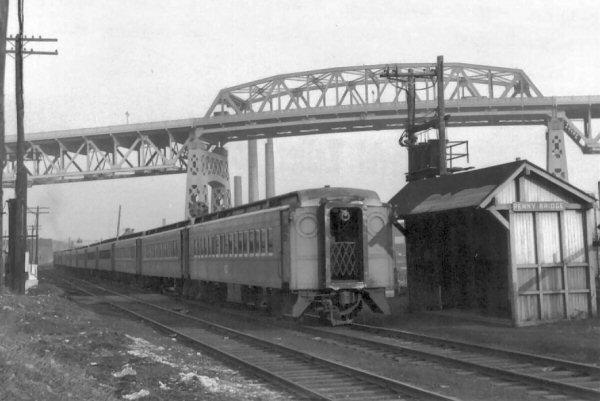 |
| Penny Bridge station (Photo Credit: Dave Keller Archive) |
Haberman was a small station located in Maspeth on Maspeth Avenue in Queens [map]. It had a short, low-level platform. The station opened around September 1910 and still had manual railroad crossing gates and a guard shack as recently as 1973. This station had just three daily riders when it was closed in 1998.
 |
| A view of the former Fresh Pond Station, the pedestrian overpass is still visible in this photo. |
 |
| The entrance to the former Fresh Pond station, now well overgrown. (Google Street View) |
This station was to the west of Fresh Pond Yard, which is still a very active freight yard to this day. On the other side of that freight yard was Glendale station [map]. Glendale was probably the smallest of the bunch with nothing more than a stool discharging people out onto the ballast. It had just two measly riders when it was closed.
The next station to the east was the last on the Lower Montauk Branch to be abandoned, Richmond Hill. Unlike all of the other Lower Montauk Stations, Richmond Hill station already had a high-level platform. The LIRR constructed a high-level platform at this station in 1970 on the elevated portion of the branch [map]. Despite this station having a long, high-level platform, it was used by just one person in March of 1998. Even though this station would not require anything to be compatible with the C3 equipment, it would be the odd station out and keeping it open wasn't worth it for the sake of one passenger per day.
When the Lower Montauk Branch stations were closed, it was served by just two Oyster Bay Branch trains per day, one in each direction. Other trains traveled over the Lower Montauk and past these stops, but only one westbound in the morning and one eastbound in the evening made the local stops. Train 507 was the very last revenue train to travel down the Lower Montauk Branch on a daily basis before it stopped doing so at the end of October 2012.
These five stations were the only ones within New York City that were closed, and of the remaining five, one was located in Nassau County and four were located in Suffolk.
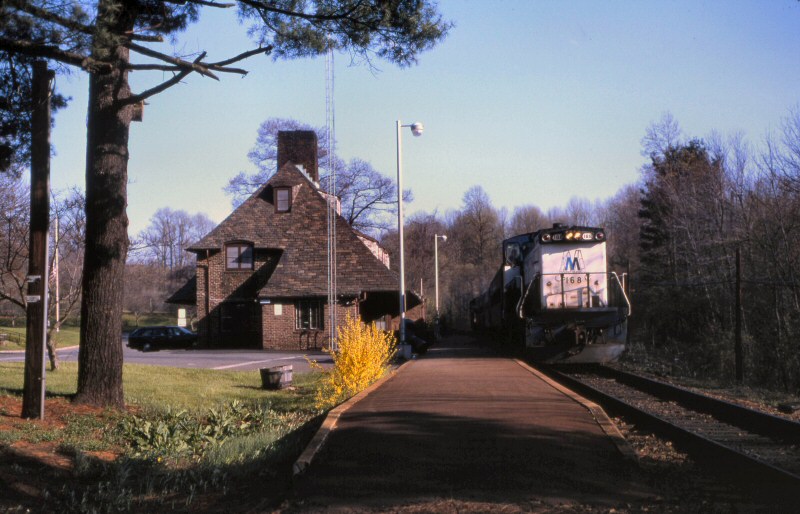 |
| Mill Neck station (Photo Credit: Dave Keller/Trains Are Fun.com) |
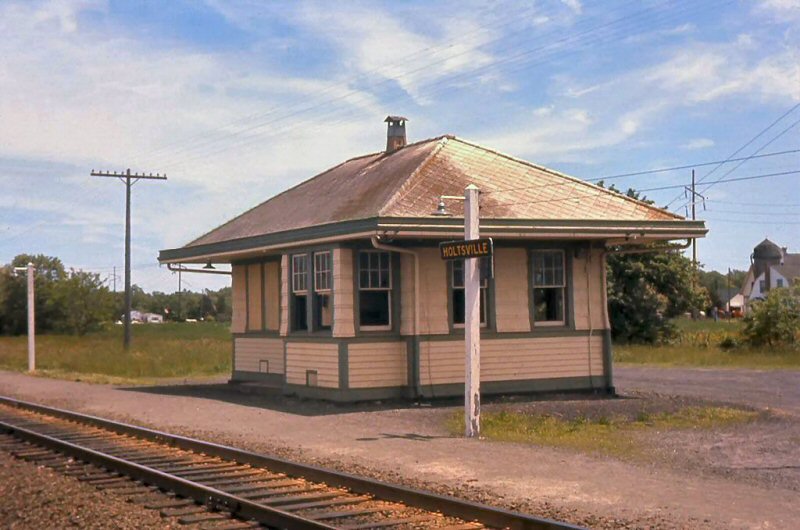 |
| Holtsville Station (Photo Credit: Art Huneke/Trans Are Fun.com) |
The station was little used back in 1998 when it was closed, but the area around the station has since grown quite a bit since then. Reopening it now would be a waste with the paltry service, but if electrification were ever to be extended out to Yaphank or Riverhead, reopening this station wouldn't be such an unreasonable proposition.
The three remaining stations closed in 1998 were along the Montauk Branch, this time on the segment east of Babylon. The three remaining Montauk Branch stations closed were Center Moriches, Quogue, and Southampton Campus.
 |
| Center Moriches station as it was in 1985 |
Some local residents have expressed an interest in getting Center Moriches station reopened. The various Moricheses in the area have grown quite a lot in recent years, and some believe that there could be enough ridership to sustain a station similar to Bellport in terms of times and service levels.
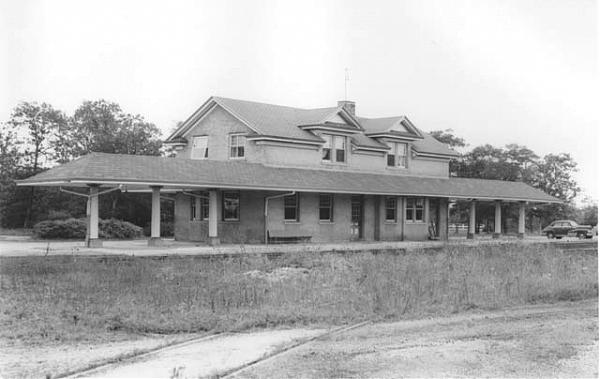 |
| The station house at Quogue, before it was razed in 1964 |
The final station closed in 1998 was the Southampton Campus station. The station was opened in 1974 to serve Long Island University's Southampton College [map]. Ridership at the station declined as attendance at Southampton College slowly declined due to various reasons (and Southampton College ultimately closed in 2005). SUNY Stony Brook has since taken over the Southampton College campus and it now goes by "Stony Brook Southampton." Stony Brook Southampton has recovered slightly, but I still don't think it's back to the point where it would warrant its own train stop. Southampton station is just five minutes to the east, and that's more than enough to serve this area's needs at the present moment.
At the end of the day, the LIRR made the decision to close all of these stations due to money issues. The money saved by not building high-level platforms at these 10 stations was not insignificant. The LIRR told the New York Times in 1998 that rebuilding these stations would cost about $260,000 to $2.25 million per station. Reactivating these stations would not be cheap, considering that in addition to a high-level platform of a length hopefully longer than a car and a half you have to build ramps and sidewalks, make parking lot improvements, install TVM's, put in AVPS displays and public address systems in, among other things.
As it stands now, reactivating any of these stations in the current phase is unlikely. I don't think passenger service will ever return to the Lower Montauk at all, and there's no extremely compelling cause to move to reopen the other stations at this point in time. I think that if infrastructure and service improvements are made (i.e. expansion of electrification, more double-tracking) then the case to reopen some of these stations can be made. If the Mainline is ever electrified out to Yaphank, as we've been led to believe, I think that Holtsville stands a pretty good chance of getting reopened, and if electrification is extended out the Montauk Branch to Patchogue then Center Moriches might have the chance. The communities around Mill Neck, Quogue, and Southampton Campus still have some way to go before they could be reasonably expected to sustain rail service there.

Re: Center Moriches station. Brookhaven Town Supervisor Ed Romaine again told the folks at last week's Moriches Bay Civic Association meeting that he will continue to pursue with LIRR having our Center Moriches station reopened.
ReplyDeleteEd also said he will continue to pursue having the Yaphank station on the Main Line relocated 2&1/2 miles east to William Floyd Parkway, near Suffolk County Police Precinct 7. The desire to move the station to that location is being driven in part by the planned development of the former Parr Quarter Horse Racetrack property.
One more thing about the Center Moriches station: In the photo of the original station house note the historic spelling of our community as "Centre Moriches". In my youth (1950s) there was still a ticket agent, and the building had an honest to goodness working pot bellied stove to provide warmth in the winter. This station house was torn down in the 1960s. For nearly 20 years there wasn't even a shelter until the one seen in Patrick's 1985 photo. This shed/shelter was built as an Eagle Scout project, built with donated materials. There was quite a hoopla surrounding the dedication of this new shelter. LIRR officials and local area politicians arrived on a train for speeches and a shed dedication ceremony. The shed was draped with bunting. The Center Moriches High School band played for the occasion (my daughter was in the band at the time). Even the Center Moriches Board of Education got in on the act! And then in April 1998 LIRR service came to a screeching halt per the reasons described by Patrick. In time the shed also disappeared, as it became the target of vandals. Some of us have never given up on the idea of our station and LIRR service being returned to us. 16 years later, our numbers are growing, and now there is at least a glimmer of hope.
ReplyDeleteThe Lower Montauk could have served as a cleaner ESA implementation with a 2 mile tunnel bridging them instead of convoluting Sunnyside yard even further. Sort out the GCT bound trains at Jamaica and you got yourself a whole lot more capacity.
ReplyDeleteInteresting idea.... Many years ago when East Side Access first got started, I believed that the routing would involve new tunnels from Long Island City yard, right under the Hudson, and up into Grand Central from the south. That way they could run trains over the Lower Montauk to the GCT tunnels and save the mess at HAROLD.
ReplyDeleteIt would also be very good for congestion on the Mainline in general, which can be a problem at times.