
Today, we'll take a quick look at INWOOD interlocking. This is one of the few interlockings on the stretch (with EMPIRE and CP JERVIS being the only other two, much further to the south). For much of its territory in Manhattan, the Empire Connection is double-tracked, allowing trains to pass in both directions. INWOOD is the point where the two tracks merge into one, and the train slowly crosses the Harlem River on a moveable bridge.


A wooden railroad bridge across the Spuyten Duyvil was first constructed by the New York & Hudson River Railroad in 1849. That crossing was later removed in favor of the current steel bridge that was designed by Robert Giles and constructed in 1900. The bridge's piers rest on pile foundations in the riverbed.

When freight operations down the West Side Line into Manhattan ceased in 1982, the bridge laid dormant. The following year the bridge was damaged by a vessel and left stuck in the open position. In conjunction with the rest of the West Side Line, the bridge was rehabilitated in the late 1980s by Amtrak and Amtrak's Empire Service trains began using the Spuyten Duyvil Bridge for service into New York Penn Station on April 7, 1991, following the completion of the Empire Connection. The bridge originally opened with two tracks, however, during the 1980's rehabilitation of the bridge, only one track was restored, and the easternmost of the two now runs across the bridge.
 The current single-tracked nature of the bridge is not really a choke-point for Amtrak at the moment. Considering Amtrak currently only runs 30 or so trains over the span daily, there is plenty of room in the schedule to let the trains move across this bridge without running into each other. And considering the segment of track is only single-tracked for about a mile, it's not that much of a concern. However, should Amtrak's Empire Service become wildly popular one day and twice or three times the amount of trains that are currently run need to traverse the bridge, it would not be all that difficult to add a second track.
Today, the bridge is used by approximately 30 Amtrak trains each day and is opened over 1,000 times per year, primarily during the summer months for Circle Line Sightseeing Cruises and recreational vessels.
When you look at photos of the bridge, it's clear that the bridge lies very close to the water. This is necessary due to the fact that the tracks on the north side of the bridge need to be kept at grade so it can quickly merge in with the Hudson Line not much further north than here. When the bridge is opened, it swings outwards allowing vessels to pass through. I have included a number of photos of the bridge at the right-hand side of the page.
This junction, which was the site of the unfortunate December 1st derailment of a Hudson Line train near Spuyten Duyvil, is where Metro-North's Hudson Line curves to the east and heads towards Grand Central Terminal. From this point, the distances to either Grand Central or New York Penn are pretty similar, especially since the curve around Marble Hill was straightened many, many years ago.
CP 12 is a Metro-North interlocking that is controlled by Metro-North dispatchers in Grand Central. INWOOD interlocking is controlled by a dispatcher located in the Penn Station Central Control building (not with the exact people who control the Penn Station interlockings, but on the other side of the room).
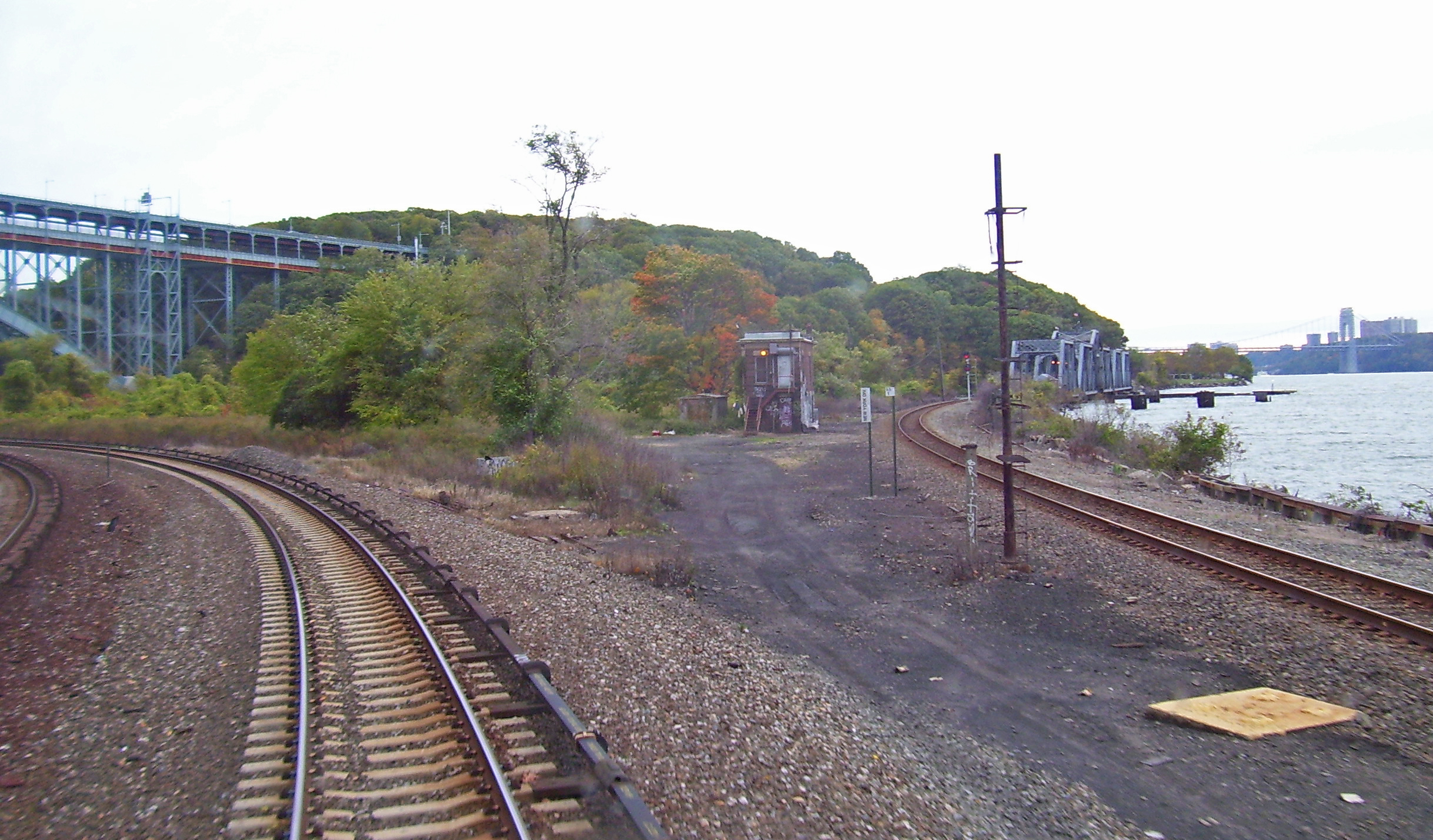
And if Metro-North's Penn Station Access plan ever becomes a reality, this would be the location where the trains to Penn Station would diverge. There is more on that in this post about Penn Station Access, which I published last June.
So, to wrap up, INWOOD interlocking is a small little interlocking that has a pretty interesting story behind it. In the next two or three weeks we will round off the very last of the interlocking walkthroughs with similar looks at the Amtrak interlockings up the Hell Gate Line towards Boston.

Really enjoy these posts. Does PSCC also control the opening and closing of the bridge?
ReplyDeleteThe dispatcher in Penn Station Central Control gives the word to open or close the bridge, but the actual physical throwing of the switch is done by someone station on the bridge. The Coast Guard wants a set of human eyes on almost all moveable bridges at all times to ensure that the bridges fully open, fully close, etc., and there's no chance for a train going into the river or a boat knocking into the bridge.
ReplyDeleteEventually, the LIRR will close all but one of its towers and consolidate everything into the Jamaica Control Center. The one tower they will probably not be able to close will be LEAD tower, because of the Coast Guard's desire to have a set of human eyes on the bridge at all times.
I typically take the train from Roslyn to Penn anywhere from 0 to 3 times a week (average 1). Sometimes i'll go from Mineola (timing) , Syosset (body shop), or Hicksville (mechanic shop). I wouldn't mind having more time options from Roslyn. I'm sure at least some of the trains wouldn't be three stops. For instance, this week I took the 6:19 which was direct and the 8:45 which had transfer... I do agree and understand that i am in the minority. Oh, but if i had to do some cockamamy walking up and over or anything like that, i would be against it.
ReplyDelete