
These two stretches of territory are on the far eastern end of Long Island:
- on the Mainline from Ronkonkoma to Greenport
- on the Montauk Branch from Speonk to Montauk
Signal systems are commonly made up of blocks. If a signal block has a train in it, it is considered an occupied block, and the signal system won't let other trains in the blocks immediately following the occupied block. The exact workings of the signalling system vary from application to application, as on the LIRR alone there are a number of different types of signalling and applications thereof.
A Manual Block system is set up of a series of blocks, and train movements through those blocks are set up manually. In some circumstances, railroads will take the entire stretch of dark territory and consider it one long block where there can only be one train along the entire stretch at the same time. However, it is possible to carve that long stretch up into a number of smaller blocks. Having the smaller blocks allows more than one train to move about in the dark territory.
The smaller blocks within the stretch of dark territory are marked off by what are called "Block Limit signals". These signals are found at the boundaries of these different blocks and mark off where one block begins and one block ends. On the LIRR, block limit signals look like this:
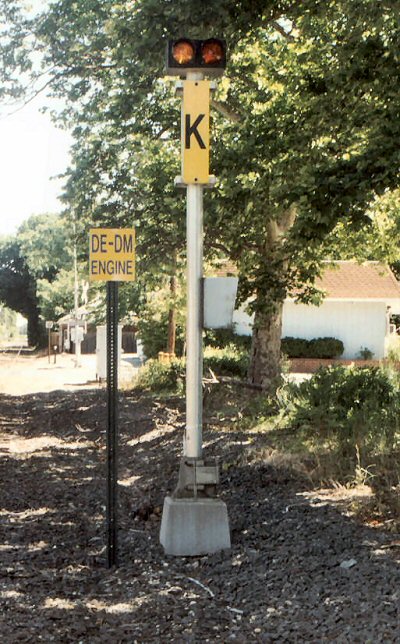 |
| BL K, a LIRR Block Limit signal east of Mattituck (Photo credit: Dave Keller Archive/Trains Are Fun.com) |
Now this is the part where many people get confused. Block Limit signals always, and in all circumstances, say the same thing: do not pass this point without permission.
There can be one train, or there can be 10, it can be morning, noon, or night, but the signal always says the same thing. The lights on the signal only really tell you which track the signal is governing. It doesn't tell you if there is a train ahead or if it is safe to go on, it just tells you that the track next to the yellow signal is the track that the signal is governing. You essentially don't even need the lights at all (and, in fact, Metro-North's block limit signals don't have lights, they just have yellow and red reflective squares on their block limit signals, as seen in some of these photos). But the LIRR didn't jump on the NORAC bandwagon when that version of operating rules came about, so block limit signals with lights remain on the LIRR.
Put simply, a LIRR train moving through a Manual Block works like this:
- A train that arrives at the Manual Block calls the operator and request permission to enter the block.
- The operator checks to be sure that there are no trains in the block at that moment (they have no automatic way of doing this, they have to keep track of it by themselves). If there are no trains currently in the block, the operator gives the train permission to enter the block.
- The operator gives the train permission to enter the block by issuing something called a "Form L" or a train order to trains. The Form L (which has since essentially replaced K Cards) gives the train permission to enter the block and it instructs the train to report that they have cleared the block at a certain location (or report their arrival at a certain location) back to the operator. A photo of a blank K card (which was used to give trains clearance up until a little while ago when it was essentially replaced by Form L's) can be seen on Trains Are Fun.com.
- Once the train has received permission to enter the block, it runs through the block as normal.
- After the train has cleared the block (i.e. reached the next block limit signal, or the end of dark territory) the train reports that it is clear of the block back to the operator. At this point, another train can then enter the block.
- If a westbound train is leaving dark territory and crossing into stretches of track where there are signals, they report they are clear of the block and continue on their merry way. Trains that are entering another Manual Block just simply repeat this process over and over again until they get to the end of dark territory.
Under this system, there can only be one train in any given block at any given time. Even if the trains are traveling in the same direction, a train must wait for the train ahead to completely exit the block before that train can enter (in contrast to territory with cab signals or wayside signals where trains can tail each other at slower speeds). Trains can also meet each other at these different block limits (i.e. passing sidings where two blocks meet) allowing trains going in opposite directions to pass.
The LIRR's two stretches of Manual Block territory are configured into the following blocks. Going from west to east, the blocks on the Mainline are split up as follows:
- KO 2 Interlocking, ASC territory begins here for trains traveling west. (MP 49.4)
- YA (Yaphank - MP 58.6)
- MR (Manorville - MP 65.1)
- AH (Calverton - MP 69.1)
- LD (Riverhead - MP 73.3)
- R (Jamesport - MP 78.3)
- K (Mattituck - MP 82.4)
- SD (Southold - MP 90.1)
- GY (Greenport - MP 93.6)
- Greenport Station, end of line (MP 94.3)
On the Montauk Branch, Going from west to east, the blocks are split up as follows:
- SK 2 Interlocking, ASC territory begins here for trains traveling west. (MP 71.6)
- WH (Westhampton - MP 74.3)
- ND (Hampton Bays - MP 74.3)
- SN (Southampton - MP 89.4)
- BH (Bridgehampton - MP 94.1)
- AG (Amagansett - MP 104.3)
- MY (Montauk - MP 114.8)
- Montauk Station, end of line (MP 115.8)
As you might have been able to tell thus far, the old fashionedness of dark territory makes working around things difficult. Everything runs pretty smoothly when the trains are on schedule, but once trains become delayed or once meets have to be moved, things can go sour quite quickly. A train can be sitting at a station for quite a while waiting for a late train ahead to clear out of the next block, and meets in MBS territory have to be done on sidings with manual switches, making the train that has to wait on the siding sit there for a few extra minutes while the crew gets down and throws the switches by hand.
At some point, much of the LIRR was dark territory, but over the past few decades, the LIRR has slowly brought cab signals and more modern railroad technology to the remaining parts of their system. Most recently, the LIRR signaled the entire West Hempstead Branch back when they rehabilitated VALLEY interlocking, and the LIRR installed new signals from Patchogue all the way out to Speonk in 2006 (at one point everything east of Patchogue was dark territory). The railroad is currently working to scrub out one of the above stretches of tracks as part of the Speonk to Montauk Signalization Project, which will bring signals and interlockings to the remaining part of the Montauk Branch.
The LIRR's plans for signalizing the Mainline are still a bit unclear at this point. The most recent indication coming out of the railroad is that they are very likely to signalize out to Yaphank, there is a chance that they will go as far as Riverhead, but it is unlikely that they will ever fully signalize out to Greenport, at least at this point in time. This could be considered acceptable once you consider the current ridership on this segment of the Mainline, and even signalizing to Yaphank or Riverhead will help Mattituck, Southold, or Greenport passengers slightly.
In the end, Manual Block signalling is a rather old-fashioned way of moderating train movements over segments of tracks that typically see just a small handful of trains. Ideally, the LIRR will make an effort to signalize whatever they can (and it appears that they are looking to do that in the name of saftey--as there is absolutely no automatic speed control or way to keep train speeds in check once they venture off into dark territory). As someone who traverses 44 miles of dark territory daily, it works just fine when things run smoothly, but it can create awful headaches when you try to weave lots of additional trains in and out, and for that reason, it's important that the LIRR signalize as much as possible, as soon as possible.

I'm curious, if signals were only put up in Speonk in 2006, was it still a terminal station back then? Did Montauk trains run exclusively to either Patchogue or Montauk, or was Speonk still used due to either ridership, track layout, or the presence of the yard?
ReplyDeleteI know that mainline trains run to either Yaphank or Riverhead and very few hit Greenport, so I'm guessing Speonk was still used often, I'm just curious anyway.
Speonk was always a terminus and the traditional end of South Shore commuter service.
ReplyDeleteThe distinction between Yaphank, Riverhead, and Greenport when it comes to PTC has primarily to do with the amount of freight service on the line, with none east of Riverhead. Where freight is present, the no-PTC alternative involves so-called "temporal separation", or the installation of physical means to prohibit freight and passenger traffic from being anywhere on the line at the same time. This costs money and limits windows for passenger and freight operations. Hence why the long term goal is to get PTC out to Riverhead, and the passenger-only segment east of there can be easily worked with even if the FRA imposes a one train at a time rule.
ReplyDeleteThanks for asking permission to use that K card scan.
ReplyDeleteOther than the recently added summer trains, regular weekday commuter service to Speonk and Montauk have been pretty similar to what they are today for some time. Other than maybe seeing new signals off the end of the platform, the average commuter would hardly notice the extension of 261 out to Speonk.
ReplyDeleteI seem to remember reading something about the "five minute rule" somewhere on another site relating to manual block operations. Does that only apply to meets in dark territory? As the article doesn't mention but also didn't get into how meets are conducted in dark territory. Or is that Norac or something not applicable to the LIRR? Or am I just completely off the wall?
ReplyDeleteI am not aware of any strict time boundary set out by the operating rules, but the meets in dark territory are customarily padded in excess of five minutes due to the fact that the switches have to be hand thrown, and that things are often very unreliable at that point in the game (i.e. when summer Montauk trains meet on weekends), so they have to pad it enough so delays do not cascade.
ReplyDelete