
 |
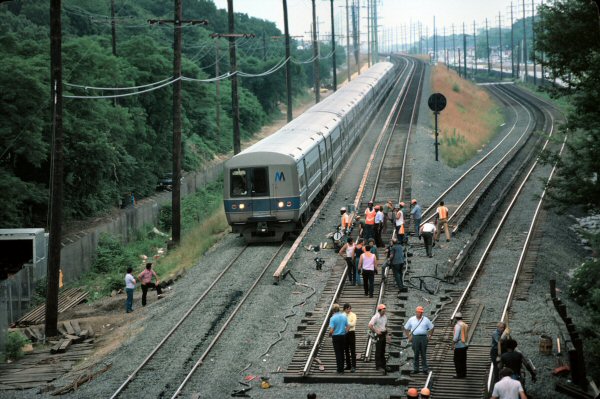
| Photo of the lead car of train 2065 (Photo: Janelle Clausen/The Island Now) |
Service was suspended following the crash, and the LIRR operated limited rush hour service through the area, with significant delays, on Wednesday and Thursday. Most service was restored in time for the evening rush hour on Thursday. The railroad reported that roughly 200 feet of track was damaged during the incident.
 |
| School Street Grade Crossing in Westbury (Photo: MTA) |
While the number of injuries onboard the train was low, we need only think of the 2015 Valhalla grade crossing crash, or one of many others, to see how this could have turned out much worse. According to FRA accident prediction values, which try to assign and assess risk of grade crossing accidents, the School Street crossing had an accident prediction value of 5.439%, ranked 47th on Long Island. The last fatal accident at this crossing was in 2009. Roughly 211 trains and 9,068 cars cross paths here on a typical day.
As far as how LIRR handled service as they cleaned up after the incident, they did a fairly decent job, showing marked improvement compared to previous incidents where they made blunder after blunder. The trains they did cancel to single-track through the area were reasonable and well thought-out (and not just the standard checklist combinations they always use), and stops were added to other trains to keep train service moving for passengers bound for all stations, not just the major ones. Someone who commutes to/from New Hyde Park remarked to me that service was actually more frequent than it was on a normal day, on account of all Huntington/Port Jefferson trains making local stops.
The railroad still needs to do a better job of accounting for known delays, though. If the incident is going to require trains to operate at reduced speeds for an extended period of time (elongating travel time), that needs to be accounted for and communicated with both accuracy and precision. By just running the trains and allowing them to be delayed, congestion and knock-on delays are created as they move through Jamaica or into NY-Penn Station out of turn. The LIRR had the same problems during following the 2015 Wyandanch DEF freight train derailment. If there's a known delay, the railroad should give more thought to more actively managing delays, and having trains leave their eastern terminals earlier, so they can operate through the slow area and come out the other end on or close to their original schedule. For example, if the slow zone through Westbury was delaying most trains by 15 minutes, have the 6:39a train leave at 6:24a instead, then when it operates through the slow zone, it is back close to its original schedule, and it can slot through Jamaica or into NY-Penn Station normally. This not only reduces knock-on delays for other branches, but it allows people on the directly affected trains to know in advance how much extra time they have to leave, and it gives them the opportunity to get to their destination at or close to their original arrival time.
One major deficiency, however, was the total suspension of reverse-peak service on Wednesday and Thursday (in the morning only). Most Main Line reverse-peak trains were canceled without alternative transportation provided, causing a roughly three-hour gap in rush hour service, which is not acceptable. While definitely not convenient, much better effort needs to be made to maintain service for all riders, in both directions. At the bare minimum, alternative transportation needs to be made available, and details communicated in advance. This is especially necessary for reverse-peak ridership, a market the LIRR desperately needs to grow and one generally with much less flexibility to use alternate branches, since you're commuting to work and likely don't have access to a car on LI.
Managing grade crossing risk
While driving around lowered grade crossing gates (whether or not there is a train oncoming) is clearly wrong, the railroad could be doing a better job of managing grade crossing risk. While the LIRR is working on eliminating seven grade crossing as part of the Main Line Grade Crossing Elimination project, the railroad does not have a comprehensive plan to eliminate dangerous grade crossings elsewhere on Long Island. |
| A tractor collided with LIRR's TC-82 track inspection vehicle at a desolate private crossing in Laurel (Newsday) |
Properly managing grade crossing risk requires identifying which grade crossings are the most dangerous, which crossing eliminations would bring the most benefit, and which eliminations would be the most practical. The Federal Railroad Administration has a Web Accident Prediction System that considers the likelihood an accident would occur in a particular year. Crossings are assigned a value from 0 to 1, with the higher value meaning a higher probability. More information about the FRA's APV figures and what some of the abbreviations mean can be found in this file from 2015. You can find the most recent accident prediction values for Long Island grade crossings in this file in The LIRR Today's document library. While there are of course a wide variety of factors that determine the risk at a particular crossing, only some of which are considered by the FRA's WAPS, the following crossings are the ones the FRA's estimations suggest have the highest risk:
| Rank | Crossing | FRA APV | Accidents 2009-17 | Warning Device | Trains | Max Speed | Cars/ train |
|---|---|---|---|---|---|---|---|
| 1 | Broadway (Bethpage) | 0.20066 | 4 | FG | 76 | 80 | 114 |
| 2 | Carlton Avenue (Central Islip) | 0.18781 | 4 | FG | 71 | 80 | 280 |
| 3 | Urban Avenue (Westbury) | 0.17189 | 3 | FG | 211 | 80 | 27 |
| 4 | Glen Street (Glen Cove) | 0.16716 | 2 | FG | 35 | 30 | 533 |
| 5 | Washington Avenue (Brentwood) | 0.16503 | 5 | FG | 76 | 80 | 291 |
| 6 | River Avenue (Patchogue) | 0.12126 | 2 | FG | 51 | 40 | 107 |
| 7 | Covert Avenue (New Hyde Park) | 0.12083 | 1 | FG | 211 | 80 | 57 |
| 8 | Robbins Lane (Jericho) | 0.11922 | 2 | FG | 99 | 80 | 145 |
| 9 | Commack Road (Deer Park) | 0.11905 | 2 | FG | 76 | 80 | 299 |
| 10 | Ocean Avenue (Ronkonkoma) | 0.11596 | 1 | FG4 | 71 | 80 | 435 |
 |
| The Broadway crossing in Bethpage (Google Street View) |
Only two of the top-10 highest probability grade crossings are currently slated for elimination (as part of the Main Line Grade Crossing Elimination project). The seven crossings the LIRR is currently planning on eliminating are the 3rd, 7th, 12th, 36th, 47th, 55th, and 66th most likely to see an accident, according to the FRA:
| Rank | Crossing | FRA APV | Accidents 2009-17 | Warning Device | Trains | Max Speed | Cars/ train |
|---|---|---|---|---|---|---|---|
| 7 | Covert Avenue (New Hyde Park) | 0.12083 | 1 | FG | 211 | 80 | 57 |
| 66 | 12th Street (New Hyde Park) | 0.04535 | 1 | FG | 215 | 80 | 12 |
| 36 | New Hyde Park Road (NHP) | 0.06496 | 1 | FG | 211 | 80 | 79 |
| Station Plaza Road (Mineola) | FG | 211 | 80 | ||||
| 55 | Main Street (Mineola) | 0.05230 | 0 | FG | 211 | 80 | 32 |
| 12 | Willis Avenue (Mineola) | 0.11413 | 1 | FG | 211 | 80 | 34 |
| 47 | School Street (Westbury) | 0.05439 | 1 | FG | 211 | 80 | 43 |
| 3 | Urban Avenue (Westbury) | 0.17189 | 3 | FG | 211 | 80 | 27 |
Eliminating grade crossings as part of a larger system expansion project (like LIRR is doing between Floral Park and Hicksville) is a fair idea, since you often have to modify existing crossings as part of the work. While the LIRR is doing this between Floral Park and Hicksville, they did not eliminate any crossings as part of the Ronkonkoma Branch Double Track Project, which was a big missed opportunity. Four of the top-10 crossings with the highest accident prediction values on LI are located on the Main Line between Farmingdale and Ronkonkoma (a fifth is located between Hicksville and Farmingdale), but none were eliminated. The 27 grade crossings on the Main Line east of Hicksville have an average APV of 0.08121. Only the Port Washington Branch (with its single crossing at Little Neck) has a higher average APV.
When it comes to identifying grade crossings, it is important to prioritize the most dangerous ones, including crossings that see high volumes of train and/or car traffic, crossings that prevent platform extensions or standardized platform lengths, and crossings in downtown or otherwise high pedestrian areas. Grade crossings in electric territory or immediately next to stations also carry additional risk, which should be considered.
 |
| Photo of the Roslyn Road underpass (Longi Engineering) |
Any true modernization of the LIRR should include significant grade crossing eliminations. Grade crossings have been largely eliminated on peer regional rail systems in Europe, with crossings typically remaining on only outer branches with less frequent service (most systems have at least a handful of crossings, but they are usually limited...not to the extent and through as dense areas as we see on LI). While full grade separation is probably too lofty a goal, the railroad should at least have a comprehensive plan for grade crossing eliminations, identifying and prioritizing crossings for elimination, and setting reasonable targets for eliminating crossings at a rate a little faster than one every five years.
 |
| Work ongoing near Merrick as part of the Babylon Branch grade separation project, the last large-scale grade crossing elimination program, in the 1970's (Photo: William Madden) |
While eliminating dangerous grade crossings is essential, managing grade crossing risk does not mean blankly closing crossings (like the LIRR did with a pedestrian crossing in Islip in 2015), since by not putting an overpass in, they didn't really eliminate any risk, just relocated it 165 ft to the west. Nor does it mean uniformly objecting to proposals for new grade crossings, like the proposed new grade grossing in Mastic...in cases where limited ways to get across the tracks either creates congestion issues for vehicle traffic or encourages pedestrians to cross the tracks illegally, having too few crossings may only increase overall risk.
Improving safety measures
Managing grade crossing risk should also not just be limited to full eliminations. While outright eliminating all grade crossings on Long Island is impractical, there are many other ways the LIRR could improve grade crossing safety measures at a much lower cost. The LIRR's installation of flexible delineators is an example of this, but this is just one small part of what should be a much larger scheme to improve grade crossing conditions. |
| Photo of the Wellwood Avenue crossing on the Central Branch |
Additional safety measures could be added by taking lessons from grade crossing design elsewhere in the world. Crossings in the UK, Europe, and Asia typically have much more robust and comprehensive safety measures. I enumerated many of these back in 2016, and some of the chief ones are:
- Four-quadrant gates wherever possible: four-quadrant gates (where both sides of the road are protected by gate arms) is the baseline standard in most of the UK, Switzerland, and Japan. This would significantly discourage driving around lowered gates, since you can't just drive over the line and over an unprotected half of the crossing. Just four of the LIRR's grade crossings have four-quadrant gates, or about 1%, according to data reported to the FRA (Lowell Avenue in Central Islip, Ocean Avenue in Ronkonkoma, Little Neck Parkway in Little Neck, and William Floyd Parkway in Shirely). Four-quadrant gates should be standard issue on any grade crossing upgrades or modifications.
- Chains or other objects hanging down from gate arms to give the crossing arm a larger visual footprint, making them easier to see, and discourage drivers from going underneath gates. This also makes it more difficult for pedestrians to duck underneath the gates and cross into the path of an oncoming train.
- Better fencing up to the actual crossing: between the lack of four-quadrant gates and fencing/guardrails stopping before the crossing, there are lots of ways for motorists or pedestrians to bypass the boom arms. Guardrails and fencing should extend all the way to the crossing apparatus, so when the gates are lowered, there's no real way to walk or drive around the gates once they are lowered.
- Second train coming warning signs at any crossing that has a high pedestrian volume: LIRR has these at some crossings now, like Stewart Avenue in Bethpage, which is good, but they should be expanded to all high pedestrian volume crossings, or any crossing with a high volume of trains. These systems have a visual display above the pedestrian crossing and an audio warning signalling when a second train is approaching the crossing, since people frequently try to cut across the tracks immediately after the train passes but before the gates are fully raised.
- Emergency stop/signal buttons at two or four corners of the crossing: all grade crossings have a blue placard with a crossing ID and a phone number to contact in the event of problems or emergencies at the crossing. But many people probably don't know they are there or what to do in an emergency. Finding the sign can be difficult, if not impossible, at night or in poorly lit areas, since they are not directly lit. If you're car is stuck on the tracks and there's a train approaching, you are likely panicking and would have trouble finding an small, unlit blue sign. The reflex in these types of emergencies would be to call 911, but those calls go to local police dispatchers, not the railroad. The police then have to field the call, contact the railroad and pass on the information. By time that information gets to the right people at the railroad, it may be too late to stop the oncoming train. We saw the consequences of this in January, when a tractor-trailer became stuck on a crossing in Quogue...while the exact details were never made clear, it seems a nontrivial amount of time elapsed between when the driver called 911 and the train struck. Having clearly marked emergency buttons would allow riders to instantly signal the railroad with the push of a button...no fumbling looking for blue signs or trying to make a phone call. The buttons could also be integrated into LIRR's ASC cab signaling system to shunt the block and automatically stop trains before they arrive at the crossing (if they're far enough away). Japanese grade crossings frequently have emergency stop buttons; UK crossings often have phone boxes attached to directly dial the rail operator.
 |
| A grade crossing in rural UK with four-quadrant gates, chains extending down to the ground, and full fencing up to the crossing itself (Photo: Walter Baxter) |
Adequate ways to cross the tracks
The LIRR could also mitigate grade crossing risk by making sure that pedestrians have adequate means to conveniently cross the tracks. This has been an issue in the past, but has been in the news again recently following the completion of the Ronkonkoma Branch Double Track project. Prior to the double track, the railroad would have trains prefer certain platforms so passengers can board and alight on the side of the tracks closest to the parking lots: trains would generally use the north platform at Deer Park and Brentwood and the south platform at Central Islip whenever possible (Wyandanch had only one platform). With the completion of the double track, all westbound trains use the north track and all southbound trains use the south track, as is typical on two track lines. But this has caused consternation among riders, since station facilities were not upgraded to include additional overpasses or waiting areas...when peak trains disgorge large volumes of passengers, it can take a while for everyone to filter up and over the single overpass at these stations. At stations like Central Islip, people will frequently walk under the gates ahead of an oncoming train so they don't have to walk all the way to the middle of the platform and double back. Adding pedestrian overpasses and underpasses, particularly at high volume stations, would be an easy way to mitigate grade crossing risk.@LIRR @NYGovCuomo @Newsday CI station for 7:26 am train. Multiple crossers and MTA cops looking in opposite direction. ??? How is that to help the dangerous situation?? pic.twitter.com/sQ4BUtiRSN— J (@jeanniemarie388) January 17, 2019
Managing gate down time
A critical way to mitigate grade crossing risk is to aggressively manage gate down time. This is the amount of time that the crossing is activated and holding up traffic for a train.The vast majority of LIRR grade crossings are circuit-based: each crossing has three track circuits: an island circuit on the crossing itself, and two approach circuits (one on either side of the crossing). The distance the approach circuit extends out from the crossing is a calculation based on the maximum authorized speed through the area, such that the gates will be fully lowered for roughly 20 seconds before a train running at the maximum speed passes through. The crossing is activated once a train shunts the approach circuit. A train shunting the island circuit on the crossing will keep the gates down. Once a train leaves the island circuit, the crossing deactivates and the gates rise.
While these systems are simple, that simplicity also poses challenges to gate down times, as the circuits don't discern or make any adjustments for train speed. If a gate is timed for a MAS of 80 mi/hr, a train rolling through at 80 mi/hr will hold the gates down for the desired time (roughly 20 seconds)...but if a train approaches at 40 mi/hr (if it's approaching/leaving a station stop, following another train, a light engine or freight train move, etc., etc.), the circuits won't know...so a train approaching at half the MAS will hold the gates down for about twice as long as the desired time.
That causes big problems, especially in areas where trains routinely operate below MAS, like around stations. This is exacerbated at grade crossings very close to stations...a train pulling into a station will trigger the approach circuit and activate the crossing, meaning the gates are held down the entire time the train is making its station stop, which can be a minute or more in cases.
 |
| (Mike McDermet/TrainsAreFun) |
Crossing predictors, or similarly functioning systems, have been parts of some PTC implementations (since PTC systems involve much more detailed train operation information, including speed). The LIRR has not expressed any indication of further expansions in crossing predictor systems to other places on LI. The railroad's PTC implementation plan says the system will detect crossing malfunctions and enforce speed restrictions, but it does not appear PTC will be used to manage crossing gate down time. While that's probably not the best, fumbling crossing predictor installations (as Metro-North did with the Danbury Branch signalization or Denver RTD's significant problems with integrating PTC into crossing activations) can cause major issues.
Long gate down times are undesirable, for a number of reasons. If you're sitting in front of a crossing for an extended period of time, it may not take long for some to think the crossing is broken and there's no train coming, so it's ok to drive around the gates. Some may plainly just get frustrated at waiting and duck the gates. If people know that a crossing has abnormally long gate down times, motorists may also be more likely to floor it when they see a crossing first activate (running the risk of breaking the gate as they come down, or getting stuck as the train approaches)...a practice called "gate crashing" that has been on the rise recently. All of this increases the risk of a grade crossing incident.
Many circuit crossings are equipped with time release circuits that will raise the gates if a train hasn't shunted the island circuit within a certain period of time. So if a train stops short of a grade crossing, it won't hold the gates down indefinitely, in most cases. Since the circuits can't detect speed (whether it's 0 mi/hr or 80 mi/hr), the gates then do not lower again until the train slowly approaches the island circuit and shunts it, and waits for the gates to lower. Crossings immediately adjacent to stations typically do not deactivate unless the train crew manually keys the gate using a device on the platform and/or the crossing equipment itself.
This "ghost train" phenomenon, as some call it, is especially undesirable. If you see the gates lower, then go back up with no train crossing, you might think the crossing is malfunctioning, and people may be more likely to duck under or around the crossing the next time it activates (when a train is really approaching this time...and usually by now there's quite the traffic backup). Sometimes the crossing can reactivate within a matter of seconds, startling people who have started to drive across. This phenomenon is common in areas with multiple crossings in a row adjacent to a station, like Bethpage, Farmingdale, Bay Shore, Brentwood (shown in the video below), and others:
This "ghost train" phenomenon, as some call it, is especially undesirable. If you see the gates lower, then go back up with no train crossing, you might think the crossing is malfunctioning, and people may be more likely to duck under or around the crossing the next time it activates (when a train is really approaching this time...and usually by now there's quite the traffic backup). Sometimes the crossing can reactivate within a matter of seconds, startling people who have started to drive across. This phenomenon is common in areas with multiple crossings in a row adjacent to a station, like Bethpage, Farmingdale, Bay Shore, Brentwood (shown in the video below), and others:
The LIRR needs to drastically improve its management of gate down time. Whether it's installing more crossing predictors, especially in areas with multiple crossings in a row and/or proximate to stations, or leveraging PTC, holding up traffic for extended periods of time is not only unfair to motorists (railroads don't like it when marine traffic holds up rail lines at movable bridges) increases the risk of grade crossing accidents.
Multi-prong approach to crossing safety needed
While the railroad should be more aggressive when it comes to pursuing elimination of dangerous grade crossings, the lack of available funding for complete grade crossing eliminations should distract from other means to manage grade crossing risk, including smaller-scale safety and design improvements, improving pedestrian and vehicular access across tracks, and better managing gate down time. Grade crossing safety requires a multi-prong approach.Grade crossing safety is typically talked about with vigor following tragic accidents like the Valhalla train crash or incidents like this, but those talks often fade in weeks following the incident, with little translation into action. The LIRR has taken some steps to improve grade crossing safety in recent years, but much more progress is needed—and at a much more expeditious pace—to catch up to advances in technology and crossing design elsewhere in the world.


