
The LIRR’s signaling system has quite a bit of history behind it. For the longest time, the predominate type of physical wayside signal used across the LIRR was the position light signal, pictured at the right. The LIRR’s strong preference for position light signals was a holdover from its days under the auspices of the Pennsylvania Railroad, which developed the signal and used it heavily across its network. The position light signal was developed by the PRR in the 1910's as that railroad began electrifying with overhead wire, which made the previously existing semaphore signals difficult to see. They first came to the LIRR's Rockaway Beach Branch in May 1929 and later spread across most of the system.
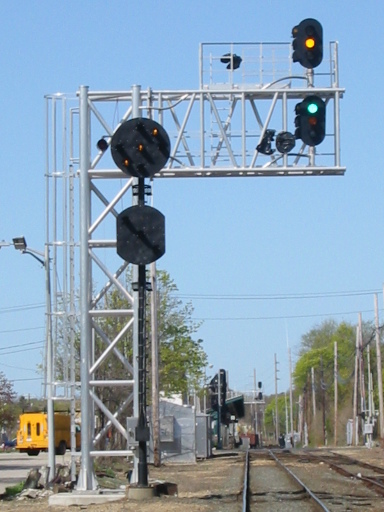 |
| An old position light signal immediately next to new tri-color light signals at Patchogue (“the LIRR’s shortest block”) (Photo: TrainsAreFun.com) |
The LIRR’s first major departure from the position light signal was the installation of tri-color light signals as part of the Patchogue to Speonk signalization project in 2006, where these signals were installed around Patchogue (PD), Shirley (JJD), and Speonk (SK). While the LIRR went back to the position light signal for interlocking projects near Queens Village (QUEENS), Valley Stream (VALLEY), and Jamaica (JAY, HALL, and DUNTON) in 2008, 2009 and 2010, they switched again to the tri-color signals for renewal projects at Wantagh and Amityville in 2011.
The LIRR is also installing many new signals throughout HAROLD Interlocking and the adjoining areas as part of the East Side Access project, but…they are installing a completely different type of signal: “G-head” type color light signals...because it wouldn’t be the LIRR if things were consistent, after all! While tri-color light signals have green over yellow over red aspects all in a column, G-head signals have them arranged in a triangular shape. Railroads like NJTransit use G-head signals extensively.
Wayside vs. cab signaling
While wayside signals are the most visible pieces of the LIRR’s signal system, train movements and spacing on the vast majority of mainline track these days is controlled by cab signals, as part of the LIRR’s Automatic Speed Control system (ASC). Only five stretches still use wayside signals to control train spacing (the Oyster Bay Branch west of Locust Valley, the entire Central Branch, the Montauk Branch between Babylon and Sayville, the Hempstead Branch east of Garden City, the Main Line west of Jamaica, and the Atlantic Branch west of East New York). You can see a map of which signal varieties are used where at this link. But in ASC territory, the speed limit for the train is conveyed directly to the train crew using a number of different cab signal aspects. In addition to conveying the ordinary speed limit on main track, it also downgrades the speed limit when trains get too close to each other, among other cases.On most of the LIRR, you will only see physical wayside signals at interlockings (controlled junctions where trains can be switched between tracks). Between interlockings, the LIRR no longer uses wayside signals, and they removed most of them during the 1970’s.
The LIRR’s sibling, Metro-North, takes this a little further and has eliminated all wayside signals except for simple “go”-“no go” signals at interlockings, and they basically have only two different indications outside of NY-Grand Central. The LIRR’s cab signal works in a similar way to Metro-North, though it is much more robust than MNR’s, but the LIRR has continued to install full signals at interlockings showing a full range of indications.
Reduced aspect signaling
The LIRR has begin to chart an entirely new course by installing reduced aspect signals (RAS) instead of full wayside signals. The railroad put in RAS signals between Farmingdale and Ronkonkoma as part of the Ronkonkoma Branch Double Track project. With RAS, instead of installing full signals, the LIRR is following more along the lines of what Metro-North does and is putting in only small dwarf signals that show a limited number of aspects (in the LIRR’s case, six instead of MNR’s two). You can a diagram/list of the new signal indications here. A photo of a new RAS signal showing “Proceed” near Pinelawn is shown below (click for full size).
New reduced aspect signal near Pinelawn (Photo: The LIRR Today)
The new reduced aspect signals bring the number of different and distinct varieties of signals currently in use on the LIRR to five (six if you count the signals Amtrak uses in and around NY-Penn Station and the adjoining tunnels). While that level of diversification in signal types is something you might see on a large railroad that has been formed by merging a number of smaller, different systems, it is certainly atypical to see one railroad go off in so many different directions (the LIRR’s composition hasn’t really changed since 1889 when the South Side Railroad was merged with the LIRR). Typically, railroads will pick one favored type of signal and stick with it wherever possible.
What is especially bizarre is how many diverging paths the LIRR has taken towards signal equipment just in the past few years. In just the last decade, the LIRR has installed four different types of signals: position lights in 2008, 2009, and 2010, tri-color light signals in 2011 and 2017, reduced aspect signals in 2018, and G-head color light signals as part of the East Side Access project.
The LIRR of course need not stick with the position light signal for the rest of time, but one would think if they wanted to go a new route, they would identify what current modern signal type was the best and stick with that in all applications, not jump back and forth depending on the direction of the wind that day. There is nothing inherently wrong with LIRR having so many different types of signals (especially because the indications are basically the same no matter which type…e.g. red over green means medium clear with position lights, tri-color lights, and G-heads), but the high level of variation does increase the propensity for human error if train crews misread or confuse a signal, and having five different signal types means the railroad needs to stock five different types of spare parts, needs to train crews on how to maintain five different types of signals, etc. It’s not the most desirable situation.
Reduced aspect signaling seems to be a good way to go this day in age, especially considering the LIRR’s ASC system is probably one of the best in the country. Fewer wayside signals and fewer aspects means there are fewer indications for train crews to memorize or potentially confuse, fewer signals to maintain, fewer signals to potentially malfunction and cause delays, fewer bulbs that can burn out, etc., etc. There is value in simplicity and consistency! Regardless of what signaling variety the LIRR thinks will best suit their needs in the 21st century, it would probably behoove everyone if they picked one type and stuck with it!
