
The idea of PTC is nothing new. It has been circulating around since the 1980's and in 1990 the NTSB added PTC to its "Most Wanted List of Transportation Safety Improvements." The fatal Chatsworth collision only reinforced the idea that PTC is urgently needed, and in Congress' "Rail Safety Improvement Act of 2008," a mandate was set that all railroads must install PTC on their tracks that meet the minimum requirements by December 15, 2015.
Not all railroads are required to install PTC on every inch of their rails. Railraods only have to install PTC if certain conditions are met for that segment of track. For passenger railroads, PTC needs to be installed on segments of track that see 13 or more trains over the course of a given day. So in theory, the LIRR does not have to install PTC all the way out to Greenport for 2-3 round trips a day (and they don't intend on doing so). Freight railroads have to install PTC if they carry more than a certain tonnage over their rails or if they are in the business of carrying certain hazardous materials. In all, 42 railroads will have to install PTC on some or all of their tracks.
The Wikipedia article for PTC does a complicated job of explaining all the different systems involved in PTC that can be hard to understand, so I'll try to present a simplified overview of what it does to give you the gist of it.
Basically, PTC takes an active role in the safe operation of the train. Currently, ASC systems, like the ones installed on the LIRR or Metro-North, only step in after the train has been already traveling overspeed and tripper arms only fly up after a train has passed a stop signal. The safety systems in place on many railroads today do work and they do serve a purpose, but that purpose is limited in its scope since most of these systems are much older and not as technically advanced.
With PTC, everything would always be in constant, active communication with everything else. Instead of doing nothing, with PTC a signal would now constantly be updating everything else on its status. It would say "I'm stop..." "I'm stop..." "I'm stop..." "I'm medium..." "I'm limited..." "I'm limited..." "I'm clear..." "I'm stop..." In this way, all of the other systems on the line would be constantly apprised of this signals status. So a train approaching this signal would be able to know all by itself, in advance, what the signal indication is.
Likewise, the train would always be updating everything else with many different things about the train's status. For example, a train would say "I'm at MP 11.6, going 71mph, with 8 cars, and no faults..." "I'm at MP 11.7, going 74mph, with 8 cars, and no faults..." In this way, the signal system always knows where every train is and what they're doing.
One of the benefits of PTC is that it allows the signal system to enforce all different types of speed limits and restrictions. Like I said Tuesday night, Metro-North's ASC system can only enforce one speed, whatever is the maximum speed that equipment operates over. The LIRR's ASC system is a little bit better since it actually transmits the speed limit to the cab and select restrictions are conveyed by "cab signal drops" so there is more protection, but PTC would be able to actively enforce everything.
PTC would be able to enforce all speed limits, permanent speed restrictions (curves, some initerlockings, etc.), temporary speed restrictions (short-term restrictions placed on track due to things like a reparable track condition, etc.), and very temporary speed restrictions (moving MoW work gangs, for example). The PTC system would know all of these speed restrictions and their locations, and they would be able to compare it to the train's location to see if it's playing by the rules. The PTC system would presumably also be able to predict things like train acceleration and deceleration, so it would be able to tell if you're not braking hard enough for the upcoming speed restriction, and PTC would take it upon itself to slow you down.
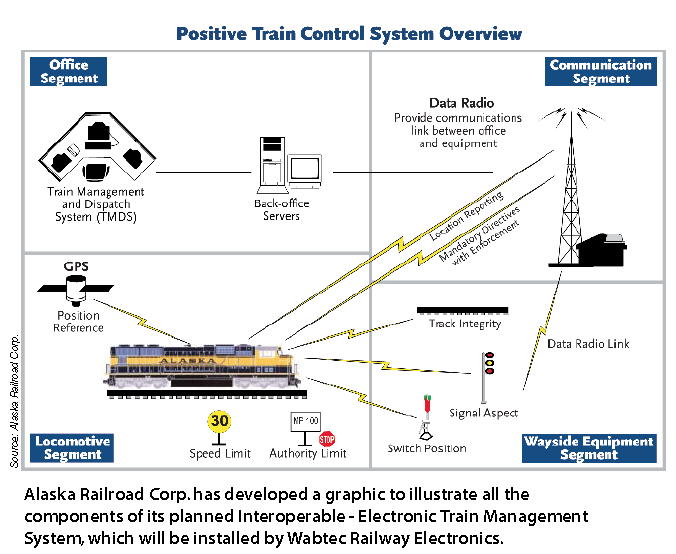 |
| This diagram (from Progressive Railroading) does a pretty good job of illustrating how everything is liked up. |
The radio overhead necessary for a system like this is huge. The signal's don't necessarily talk to each other in real English over the radio, that was just used more to give an understanding on how the system works. But everything will be communicating with each other over the radio system (think those loud high pitched sounds that fax machines or dial-up internet connections make). The amount of radio bandwidth/spectrum that is needed to go along with PTC is pretty significant and is one of the [unfortunately, many] obstacles that are slowing the implementation of PTC down.
As I write this, we are just over two years away from the PTC deadline of December 15, 2015. Are most railroads going to be able to meet this deadline? No!
As usual, the projects are very behind schedule and there has been a lot of "feet dragging" by all parties involved for various reasons. One of the largest reasons is the lack of money. In 2008 Congress said that the railroads must install this very expensive PTC system, but they did not pass bills that would help the railroads pay for this system. Some nominal funding was included, but for the most part, the burnt of the financing for this system has fallen on the railroads. This is less of a problem for the huge Class I freight railroads who are in the business of moving stuff for profit (they're not happy, but they'll survive), but the funding becomes more of a problem for the smaller or state-subsidized commuter railroads, like the LIRR. In all, the MTA estimates that it will cost $900m to completely install PTC on all of the relevant portions of the LIRR and MNCR. In the grand scheme of the MTA's huge operating and capital budget it's not a huge dent, but $900m is not an insignificant sum.
Either way, the MTA is trudging ahead with the project, albeit slowly. The MTA has said that they do not expect to be ready for the 2015 deadline. Stephen Smith got an explanation out of the MTA the other day as to why they're so behind schedule. Some of the excuses they provide are lousy, and some have a tiny bit of merit.
One of the things they mentioned is that "much of the technology is still under development and .... unproven for commuter railroads the size and complexity of Metro-North and LIRR." That's slightly misleading, since there are rail systems in Europe and Asia that are as or more complex than the LIRR and MNCR that have had functioning PTC systems for some time now. But one of the big troubles with PTC is that it supplements the current signal systems, and, as a result, it has to be overlaid on top of the existing system, as they can't really pull everything out and start from scratch (well, they could, but it would be really painful and really expensive).
Many components of the LIRR's signal system date back to the days when the mighty Pennsylvania Railroad owned and operated the LIRR. Since then, there have been new interlockings added, signals and switches replaced, towers closed, etc., so there are a lot of strange and unique challenges the the LIRR's PTC system has to fit around. Imagine the LIRR's PTC system is like a round hole, and Metro-North's is like a triangular-shaped hole. The MTA can't just go to Home Depot and get a box of square pegs off the shelf and try and shove them into the round and triangle-shaped holes. (Furthermore, the MTA can't just get two round pegs and expect the same peg to work for the LIRR and MNCR). Instead, they have to wait on line forever and go thorough this long process of custom-ordering the round and triangle-shaped pegs so that the PTC systems can work with the respective railroads. And like anything else at Home Depot, custom ordering an appliance or an entire PTC system is going to be a lot more long and expensive than it would be if they just went and got the square pegs off the shelf.
But this doesn't remove all culpability from the MTA. If they saw the writing on the wall, they should have gone out and started this process of custom ordering their stuff, that way they can still be ready to meet the deadline. If you notice one day that the old refrigerator in your kitchen seems to not be keeping your food cold enough, you would presumably see the writing on the wall, and if you had some strangely designed kitchen that required a triangle-shaped refrigerator that took a couple weeks to produce, logically, you would start the process almost immediately, that way, when your refrigerator broke not too long later its replacement would not be that far away.
There has also been the issue of acquiring the necessary radio spectrum to operate PTC with (like I alluded to above, there is an enormous radio overhead involved with a system like this). As of last month's Metro-North and LIRR Committee meeting, it appears as if the LIRR has managed to acquire all of the necessary radio spectrum needed for PTC while Metro-North has not. This is presumably an obstacle for them that they are trying to overcome as we speak.
PTC is coming. It is coming very slowly, but it's coming nonetheless. While it will make rail travel even safer than it already is, many people have been skeptical of its benefits. While the system will protect against human error a little bit more, there will still be humans operating trains for the foreseeable future, and those humans are going to have to get used to running trains along with this system that can and will throw the train into service braking if they're not following exactly along with what they are supposed to be doing. I think of it being like getting married. For the first however many years of your life you were used to doing things one way, that way is probably a perfectly fine way of doing things, but it's your way. One day you get married and the next thing you know you have somebody else living with you that insists that everything must now be done her[or, less often, his ;-)] way. What you have been doing for the first twenty to thirty years of your life up to this point was probably not wrong, but according to her [or, less often, him], this way is better so now you must do it this way.
It will be interesting to see how jumpy these PTC systems actually are. Running a train is a lot more complex than driving a car. It's more of an art form with careful accelerations and decelerations at certain points that are unique and different for each person. We don't yet know how hyperactive the PTC systems will be, for example, the PTC system might think you're coming into Mineola far to fast and slam you with a penalty brake application while you've been coming into Minoela that same exact way for the last 19 years without trouble. It will be an interesting [and bumpy] first couple of weeks as the train crews get used to the PTC systems (and the PTC systems get used to the train crews). I can see how there can be some trouble in places already, specifically in areas around places like Jamaica or Huntington where trains operate in very close proximity (during rush hour trains are often run within feet of each other with a train pulling into the station literally right behind another pulling out--something similar happens at Huntington many times a day). Hopefully we will not have too many instances of PTC systems getting confused and putting trains into emergency in the middle of interlockings during rush hour because they're trying to figure out where each train is from satellites thousands of miles away. PTC is not going to be installed around eastern terminal stations, like Port Washington, Hempstead, et cetera, for this reason, but for the big and busy stations that lie in the middle of the line (Jamaica, Ronkonkoma, Huntington, Babylon) it will be interesting to see if PTC plays nice with everything.
Anyways, the PTC deadline is fast approaching. Will the railroads get an extension of the deadline? After Sunday's derailment they're going to get a pretty hard time, so they better have a convincing case. The process is well underway, as a $421 million contract was awarded to a joint venture between Bombardier Transportation and Invensys Rail (page 72 of this pdf)to furnish the system for the two railroads, and they currently expect work to be completed by 2019. As far as I know, it seems most of the design, surveying, and layout of everything has already been accomplished in-house by the LIRR and MNCR, so all Bombardier/Invensys have to do is develop the actual hardware that is needed and then manufacture and implement it
It will be an interesting story to watch over the next couple months and years, and I'll keep you updated as we go along.
If you're interested in learning more on some of the technical aspects of PTC, Metrocomm has a pretty informative page about different aspects of PTC technology. The diagram at the bottom is interactive and clicking on the different things will give you more information about it.
